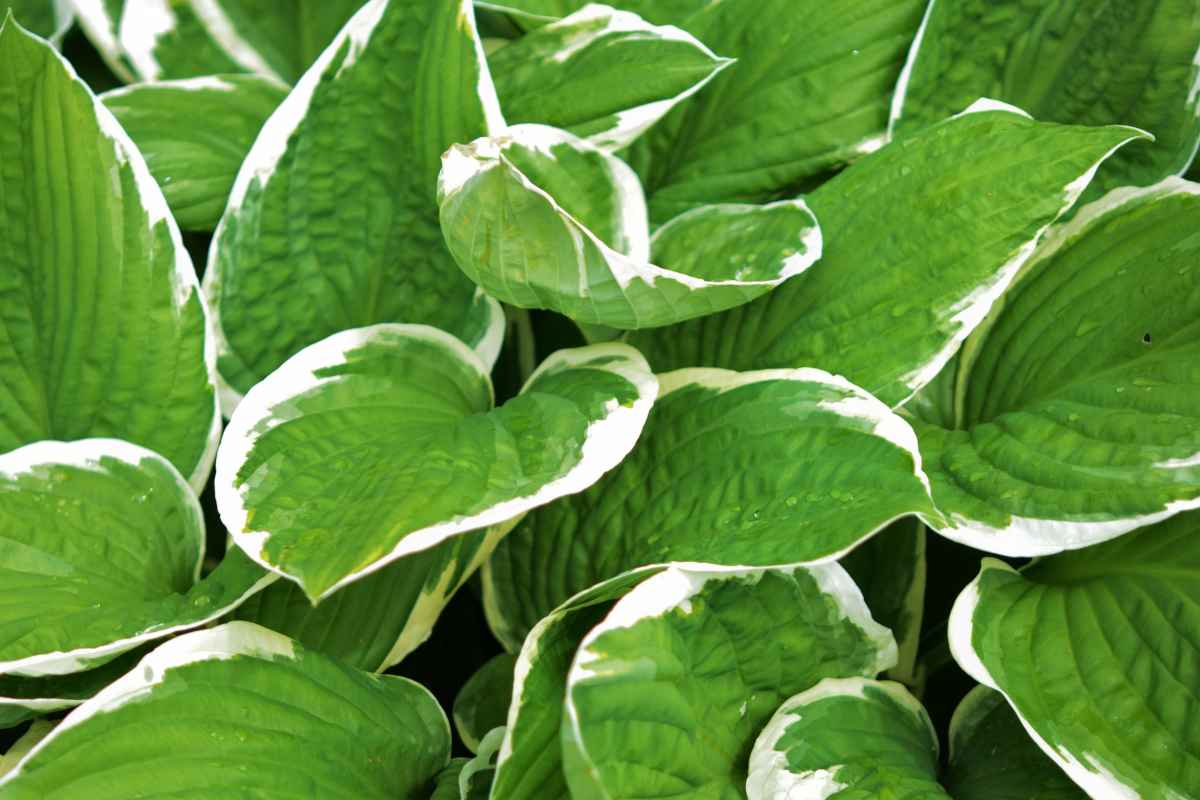
Broad oval leaves, often edged or streaked with cream, blue or gold, build into dense clumps from which cute white, sometimes violet-blue flowers rise through summer. Hosta is a fast-growing perennial ground cover for shady corners: keep it out of full sun and cool at the root, and the foliage carries the whole season.
Hosta at a glance
Name
Hosta
Family
Liliaceae (lily family)
Type
perennial
Height
8 to 32 inches (20 to 80 cm)
Exposure
part sun and shade plant
Soil
rather rich
Flowering
late spring to early autumn
Foliage
deciduous
Both in pots or in the ground, it is easy to care for and will quickly appeal to you for its numerous qualities.
Planting hosta
The first thing you should know is that hostas have a repugnance to having too much sun or heat.
For container-purchased hostas, plant preferably in spring.
Keep a distance of about 16 to 20 inches (30 to 40 cm) between plants.
Eventually upgrade your soil with conditioner such as manure and seaweed and blend them in with soil mix.
Propagate through crown division in spring or in fall every 3 to 5 years.
Spread a mulch of leaf mould, compost or bark around the clump once planted, as hosta roots want to stay cool and evenly moist all summer.
Mark the position of each clump, because hosta foliage disappears entirely in winter and dormant crowns are easily sliced through with a spade.
Pruning and caring for hosta
Hosta requires little care.
No pruning is formally required.
Care is minimal, it is a plant that is very easy to grow.
A mulch of leaf mould or garden compost spread around the crown keeps the roots cool and cuts down on watering.
Blue-leaved varieties such as Halcyon and Blue Angel owe their colour to a waxy bloom that overhead watering and handling rub off, so water at the base.
Watering hosta
Hosta, being a shade or part shade plant, fancies cool soil but scorns excess moisture.
Avoid abundant watering to keep the soil from getting too wet.
Go for regular but moderate watering.
For pots, shorter intervals between watering sessions are needed in summer to keep the soil a bit moist.
Blue hostas such as ‘Halcyon’ and ‘Blue Angel’ get their color from a waxy leaf coating that gradually wears away, so gardeners commonly water at soil level rather than spraying overhead.
Because tree roots draw water from the same soil, ground beneath trees usually dries out faster than open shade, so hostas planted there generally need moisture checks and watering more often.
Hostas prefer consistently moist but well-drained soil, so empty the saucer beneath a potted plant after watering rather than leaving the roots sitting in standing water for long periods.
If slugs invade the hosta
Slugs frequently overrun hostas because they are attracted to the leaves and shady environments.
The quickest and most adequate treatment is to spread slug-killing granules derived from Ferramol.
It is the most organic method.
Scatter slug pellets around hostas as the pointed shoots first push through the soil, because hosta leaves emerge tightly furled and any holes chewed at that stage stay visible all season.
Ferric phosphate baits are lower-risk than metaldehyde and degrade to iron and phosphate, but they are not harmless: the EDTA-type chelators they contain can harm earthworms, and large doses can sicken pets.
Thick, waxy blue-grey hostas such as the smooth-leaved ‘Halcyon’ or the puckered ‘Blue Angel’ are usually chewed far less than thin-leaved green sorts, so favour them where slugs are numerous.
All there is to know about the hosta
White hosta flowers, sometimes violet-blue, above patterned leaves
Forming very beautiful oval and multi-colored leaves, hosta also puts forth cute white flowers that can sometimes be violet-blue.
Fast-growing, it even has a tendency to spread, which makes it a splendid ornamental ground cover.
It will also merge perfectly in landscaping projects in flower beds or garden boxes.
Among the most renowned varieties one can find:
Blue Angel, France Williams, Honeybells, Wide Brim, Golden Tiara, Fire and Ice, Francee, Undulata and Golden Sunburst. Read also about perennials:
The plant travels under a second name in many catalogues — funkia, the hosta’s other name — which is why it sometimes appears twice in the same nursery list.
Smart tip about the hosta
Take care not to plant hosta in full sun because it requires cool air in summer.
Which hosta to choose
The named varieties sold in garden centres differ mostly in leaf colour and in the size of the clump they make. Use the table below to match a hosta to the space and the effect you want.
Which hosta to choose
Variety
Leaf
Mature height
Best used for
‘Blue Angel’
Very large, blue-grey, heavily veined
About 32 in (80 cm)
Bold single specimen in deep shade
‘Frances Williams’
Blue-green with a broad yellow margin
About 24 in (60 cm)
Big two-tone clumps at the back of a bed
‘Golden Tiara’
Small, green with a gold margin
About 14 in (35 cm)
Pots, garden boxes and edging
‘Wide Brim’
Blue-green with a wide cream margin
About 18 in (45 cm)
Lighting up a shaded border edge
‘Sum and Substance’
Huge, thick, chartreuse to gold
About 30 in (75 cm)
Tolerating more light than most hostas
‘Halcyon’
Smooth, intense blue-grey
About 16 in (40 cm)
Blue foliage in medium-sized clumps
‘Honeybells’
Light green, wavy edged
About 24 in (60 cm)
Fragrant pale lilac flowers in late summer
‘Francee’
Dark green with a narrow white edge
About 22 in (55 cm)
Reliable all-purpose ground cover
Written by Gaspard Lorthiois | Loves helping out, especially when it comes to growing things. Worked in herbal medicine, runs a farm, and dabbles in tech. Master's degree and engineer.