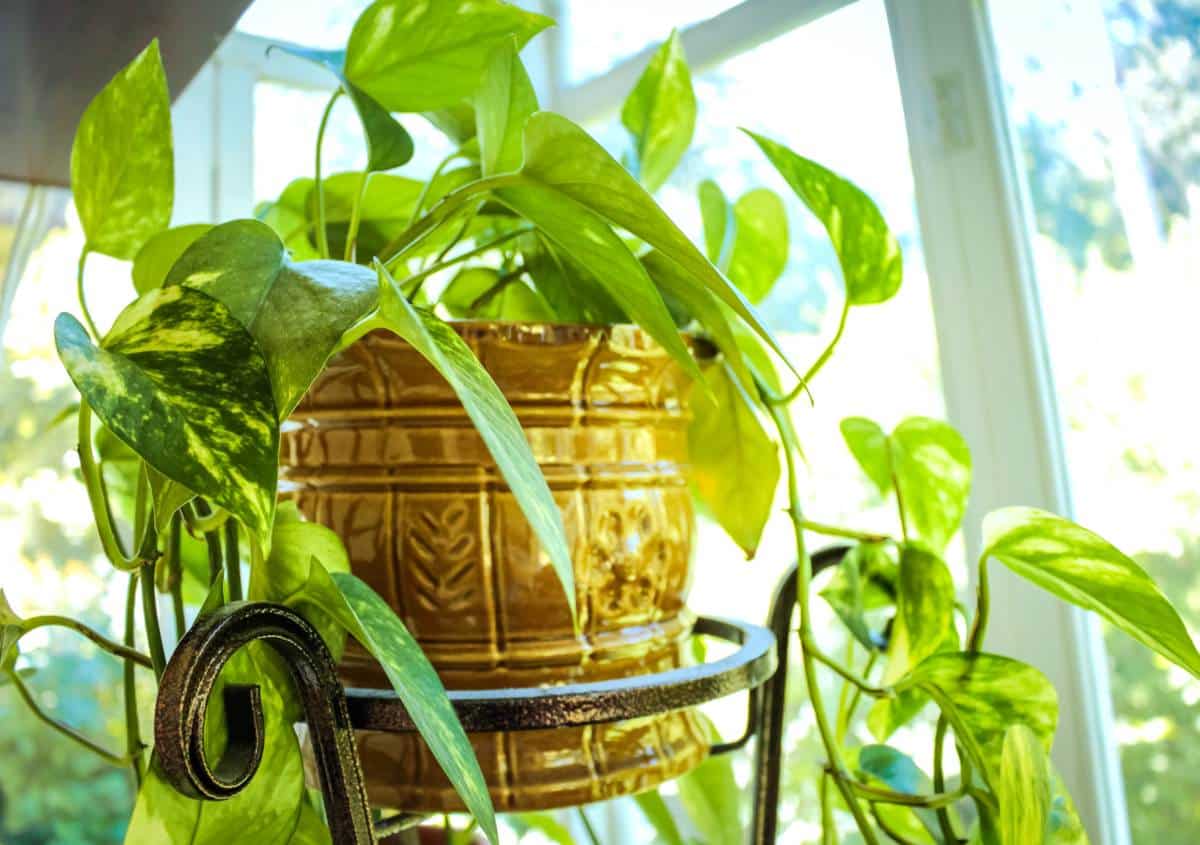
Shiny, abundant leaves, often veined with contrasting colours, either climb a lattice or dangle from a tall shelf with equal ease: that is pothos (Scindapsus), a tropical vine grown indoors for ornamental foliage and counted among the air-purifying houseplants. Give it a luminous spot out of direct sun and it needs very little care.
| Name | Pothos or Scindapsus |
|---|---|
| Family | Araceae |
| Type | indoor plant |
| Height | 6 ½ feet (2 meters) |
| Exposure | light but not direct sunlight |
| Soil | indoor plant soil mix |
| Foliage | evergreen |
| Flowering | rare as an indoor plant |
Often veined with different colors, shiny and abundant, its foliage appeals to us and spiffs up our homes. Adopt a pothos and you’ll be more than satisfied!
Pothos or Scindapsus is mostly grown in pots under our latitudes, but can be grown in the ground if it is protected in a heated greenhouse in winter.
Take note that growing pothos outdoors is only possible wherever the climate is relatively warm in winter.
Outdoor growing of pothos is only possible in tropical environments
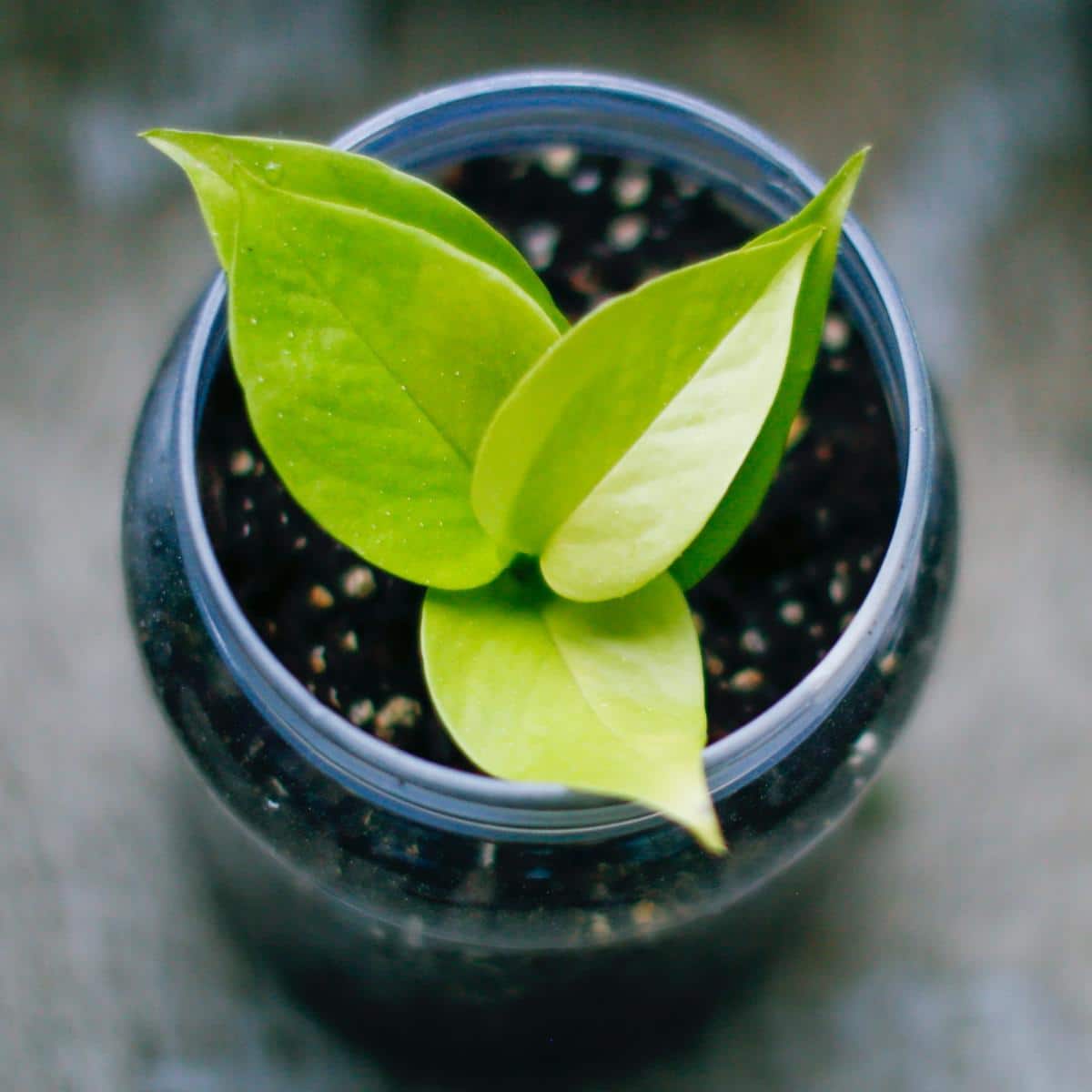
Preparing cuttings from pothos is the easiest and fastest method to propagate the plant. Also, it ensure that any properties of that variety are preserved: variegation, leaf color, vigor…
Cutting preparation is best performed in spring.
A funner solution is to simply cut a 6-inch (15 cm) stem and plunk it in a glass of water.
This works all year round.
You can also divide the pothos by collecting the offshoots that grow at its base and replant them in light and moist substrate.
Pothos can be multiplied in soil, in water, or simply by splitting off the shoots at its base. The table below sums up when to start each method and what it involves.
| Method | Best time | What you do | Next step |
|---|---|---|---|
| Soil cuttings | Spring | Take 4 to 6 inch (10 to 15 cm) cuttings, remove lower leaves, dip the base in rooting powder | Cover with a cloche or plastic pouch and keep the soil mix moist |
| Water cuttings | All year round | Plunk a 6-inch (15 cm) stem with several leaf nodes in a glass of water | Change the water every few days; pot up when roots reach an inch (2-3 cm) |
| Division of offshoots | When offshoots appear at the base | Collect the offshoots growing at the base of the plant | Replant in a light and moist substrate |
Cuttings are the fastest route and also keep the variety’s variegation, leaf colour and vigour.
Behind the single name pothos sit several species and cultivars whose variegation, light tolerance and vigour differ noticeably. The table below compares those most widely sold as houseplants.
| Variety | Leaf pattern | Light needed | Growth and habit |
|---|---|---|---|
| ‘Cebu Blue’ | Silvery blue-green, unmarked | Bright indirect | Fast climber on a support |
| ‘Pearls and Jade’ | Green, grey and white marbling | Bright indirect | Slow, small leaves |
| ‘Argyraeus’ (satin pothos) | Matt green with silver spots | Medium to bright indirect | Moderate, neat trails |
| ‘Marble Queen’ | Heavily marbled cream and green | Bright indirect | Slow, needs good light to stay white |
| ‘Neon’ | Plain chartreuse yellow | Bright indirect | Fast, vigorous trails |
| ‘N’Joy’ | Green with crisp white blocks | Bright indirect | Compact, shorter stems |
| ‘Exotica’ | Large silver splashes on big leaves | Medium to bright indirect | Moderate, broad foliage |
It isn’t necessary to prune it.
Aerial roots are very important for the plant, so it is recommended not to touch them.
In order to reduce the branches or reshape your pothos, you can shorten the stems by half in spring.
It’s a plant that loves crawling along a lattice, just as it also likes dangling down from a tall shelf.
Water the plant only when the surface of the soil is dry, and avoid excess water so as to not suffocate the roots.
Space your watering rounds as much as you can during the winter rest phase, because the plant only has very limited water needs.
However, the plant absolutely craves air moisture. That’s what makes it an excellent bathroom plant.
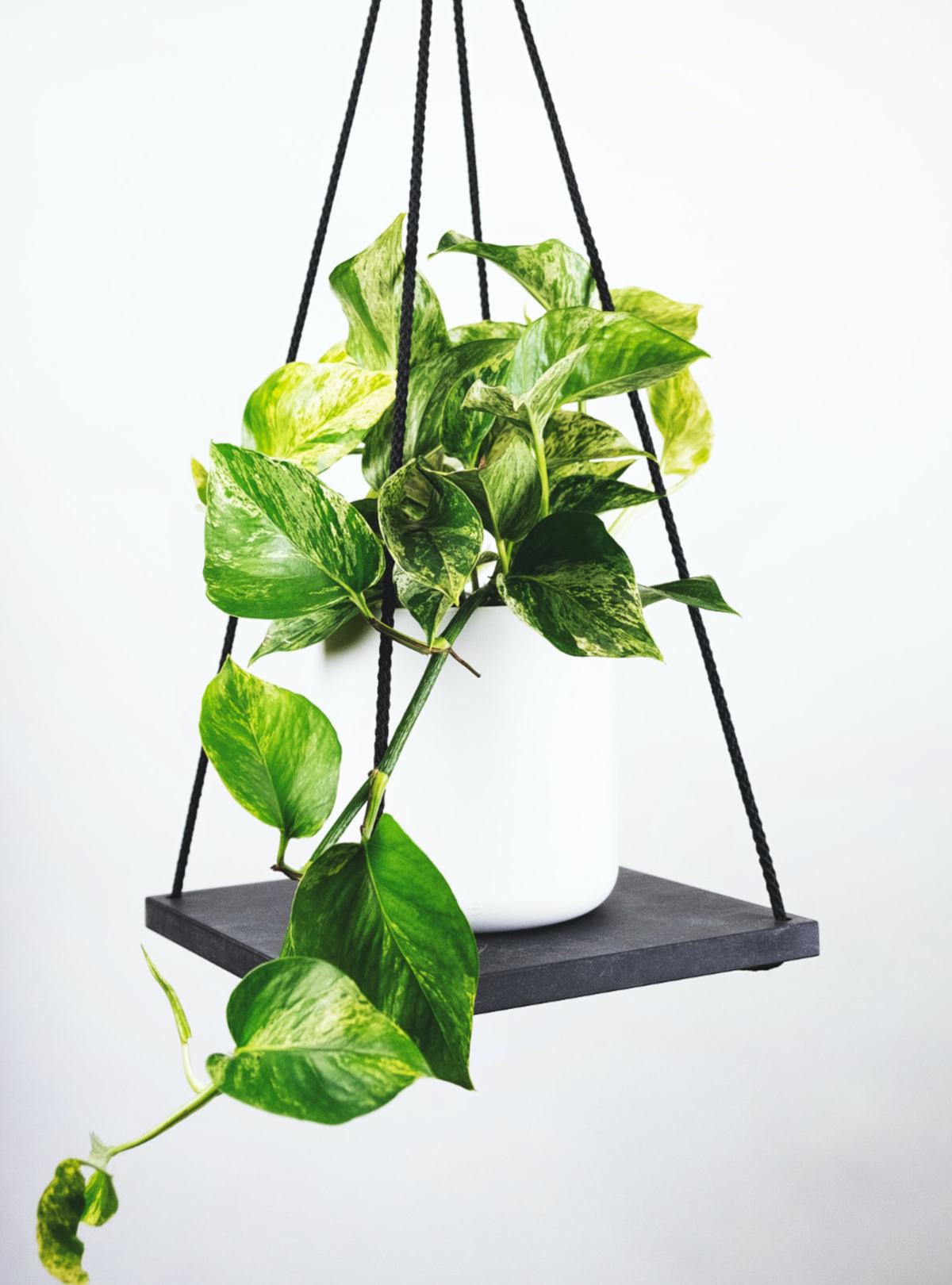
Pothos is very easy to grow. It requires very little care and resists quite well to the various diseases.
Pothos is actually a vine, either climbing or hanging depending on the lattice provided.
Although organic fertilizer can rekindle the plant’s vigor, it isn’t a requirement, either.
This plant grows indoor very well all year round, and can be brought outside from late spring to early autumn as soon at the temperature permits.
A temperature of 65 to 75°F (18 to 25°C) is recommended for proper growth.
Pothos is among the air-purifying indoor plants!